
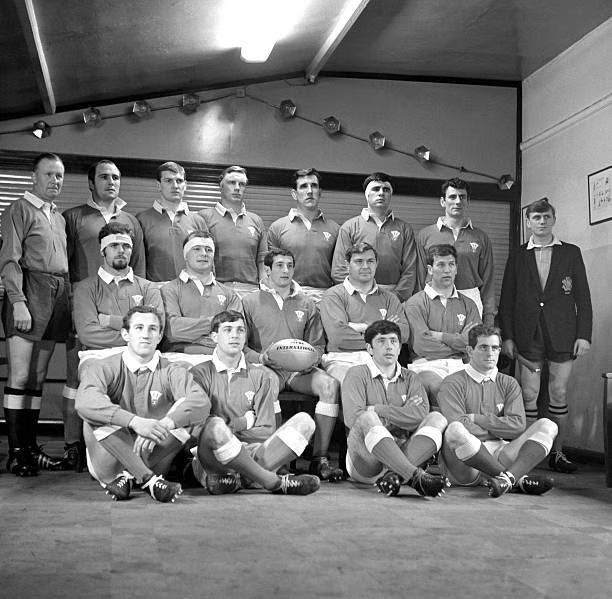
Dual-code international Keri Jones, who also ran for Wales at the 1966 Commonwealth Games, has died at the age of 81.
The multi-talented wing was a product of Ystalyfera Grammar School who then went on to train as a teacher at Cardiff Training College. He won a Welsh Secondary Schools cap in 5-5 draw with the French in Bergerac in 1963 and made his first-class debut for Neath in a 6-0 win over Maesteg in September 1964.
He played for Cardiff TC after that before joining Cardiff, making his debut for the Blue & Blacks against Glamorgan Wanderers on 12 March 1966. In the summer of 1966, he turned all his attentions to qualifying or the Wales team heading to Kingston, Jamaica for the Commonwealth Games.
Third in the men’s 220 yards in 1964 he picked up the silver medal behind Terry Davies at the 1966 Welsh Championships, clocking 21.8 sec, and did enough to earn himself a place in the Welsh team in the 100 and 220 yards, as well as the spring relay squad.
He went out in the heats in the 100 yard (10.4 sec), reached the second round of the 220 yards (22.0 sec) and joined forces with Ron Jones, Lynn Davies and Terry Davies to claim fourth place in the 4 x 100 relay. The Welsh quartet came in behind Ghana, Jamaica and Australia, but ahead of Canada, Nigeria, England and Trinidad & Tobago.
Later that year he was selected to run for the British team in an international match against Sweden in Stockholm but pulled out in favour of playing for Cardiff against Coventry. His Cardiff career took off in the 1966-67 season.
He featured in the side that beat the touring Australians 14-8 at the Arms Park and was given his first national trial in January 1967, when he appeared in the Possibles XV that beat the Probables XV 5-3 in Swansea.
He graduated into the Probables XV for the October trial ahead of the game against the touring New Zealand side in 1967. He picked up another win, 14-0 at Aberavon, and went on to earn his first cap against the All Blacks at the Arms Park two weeks later.
One of his former Wales Secondary Schools teammates, Newport No 8 John Jeffrey, joined him in winning his first cap in that game. The other new caps were Newbridge flanker Dennis Hughes and Aberavon lock Max Wiltshire.
Wales were beaten 13-6 and Jones went on to face the unbeaten tourists on two more occasions. He was in the East Wales team that drew with them 3-3 at the Arms Park and then three days later headed to Twickenham to face them again with the Barbarians.
He played for Wales throughout the 1968 Five Nations campaign, scoring tries in Cardiff in the win over Scotland and the defeat by the Grand Slam French. His form was good enough to earn him a place on the 1968 British & Irish Lions tour to South Africa, where he was joined by Cardiff clubmates Maurice Richards, Gerald Davies, Barry John, Gareth Edwards and John O’Shea.
Both Richards and Davies had played with Jones in the Welsh Secondary Schools side, and they went on to become Test Lions. Jones missed two weeks of the tour after tearing a hamstring against Rhodesia the week before the first international against the Springboks.
He played six games on tour and managed to score a try in the win over South-Western Districts. He ended up playing in five wins and one defeat, to Transvaal.
Two months after returning from South Africa, and without adding to his 60 games and 31 tries for Cardiff, he decided to turn professional and joined Wigan for the princely sum of around £7,500. He was only 23 at the time and had his best years ahead of him.
He played 57 times for Wigan, scoring 38 tries, and was in the side that reached the Challenge Cup final at Wembley in 1970. The game was won 7-2 by Castleford in front of a crowd of 95,000.
He was picked to play for Wales against England in 1970, but was forced to drop out with injury, but made the 19-man Great Britain squad for the 1970 World Cup campaign. He played in the wins over France and New Zealand that earned a place in the final but wasn’t picked for the final shoot-out with Australia.
His career then came to an abrupt end in September 1971, when he was still only 26, after on-going problems with his hamstring injury. While Wigan pleaded with him not to retire, and to seek further specialist advice, he stuck to his guns.
“I’ve lost my confidence and I’m terribly embarrassed. I’m an embarrassment to the club and to spectators,” he said.
The Wigan secretary, Geoff Sutcliffe, said: “We’ve accepted Keri’s resignation but would like him to see the specialist once more before finally finishing with the game. Keri has persevered with this injury and we understand his feelings.”
The Welsh Rugby Union sends heartfelt condolences to Keri’s wife, Andrea, and their two daughters, Lynne and Elen, as well as all his other family and friends at this sad time.
William Keri Jones: Cap No: 718 (5 caps) Lions No: #467; B: 13 January 1945 in Neath; D: 29 October 2026 in Cardiff.